
Machining is a critical process for industries ranging from aerospace and automotive to construction and electronics. This subtractive method transforms raw materials into finished products with controlled material removal. Whether manufacturing small precision parts or large structural components, selecting the appropriate machining process is vital for quality and efficiency. Each operation has distinct characteristics and benefits, allowing manufacturers to match production methods to specific design needs, material types and performance standards for any project.
The 3 Core Machining Processes
Machining processes enable the precise shaping of metals and other materials. Considering factors like the CNC machine hour rate ensures you select cost-effective production methods.
Most machining operations fall into three categories.
- Turning: This process uses a rotating lathe to make many different shapes. You can choose from various lathes to make a wide range of holes, threads and grooves. Teams can complete turning operations on internal and external workpiece surfaces.
- Milling: Milling removes material from workpieces with a unique rotating cutting tool. In manual processes, the workpiece remains stationary or moves along axes. Advanced milling machines allow the cutting tool and worktable to move for additional precision. Mills can have horizontal or vertical orientations to suit various applications.
- Drilling: Drilling makes holes in workpieces. Various drill bits are suitable for specific applications, such as creating shallow holes or widening existing holes. This machining process is valuable in the electronic, medical, transportation and construction industries.
Turning
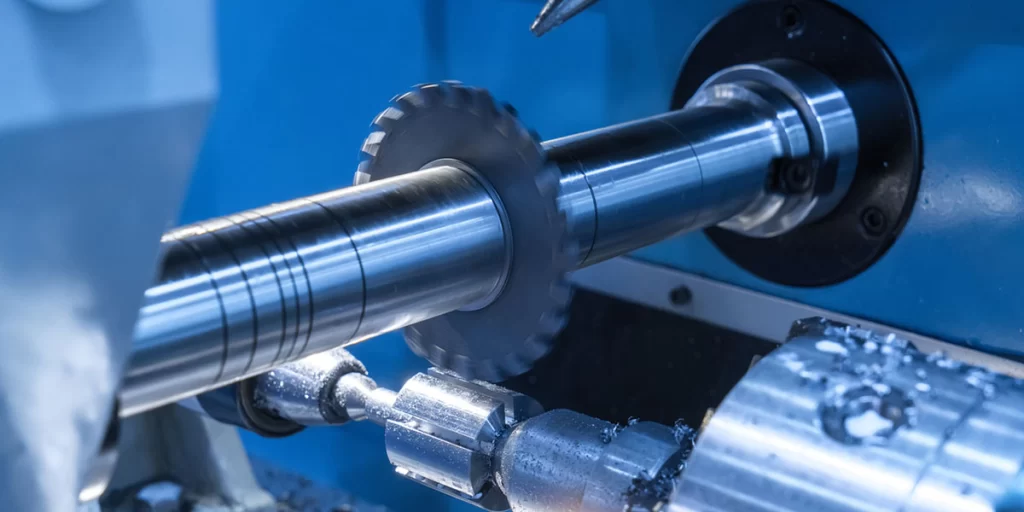
Turning operations are essential in manufacturing parts that require accuracy, reliability and a smooth finish. Their versatility and efficiency make them indispensable in industries from automotive to aerospace. During turning operations, the workpiece rotates while the cutting tool remains stationary as it removes material from the surface.
By precisely removing material, turning can achieve tight tolerances and smooth finishes essential for many engineering applications. These operations are often ideal for conical and cylindrical parts, such as engine or machine parts, bearings, bushings and shafts.
- Facing: Facing is one of the most common turning operations, often requiring a horizontal milling machine. During this process, the cutting tool moves across the end of the workpiece to produce a flat surface that is perpendicular to its rotational axis. Facing is often a starting or finishing turning step.
- Tapering: Taper turning shapes workpieces into conical forms, which is useful for components that need to fit mating parts, such as spindles or tool holders. This process shapes workpieces into cones by gradually changing the diameter along the length.
- Knurling: Knurling is a specialized technique that creates a patterned texture on a workpiece’s surface. It is functional and decorative, enhancing usability and appearance. For example, knurling can texturize machine knobs and tool handles to improve grip.
- Parting: Parting is the process of separating a finished part from the remaining stock. This process uses a thin, blade-like tool to slice through a workpiece at a precise location. The tool feeds directly into the rotating workpiece and separates the finished part from the remaining stock.
Milling
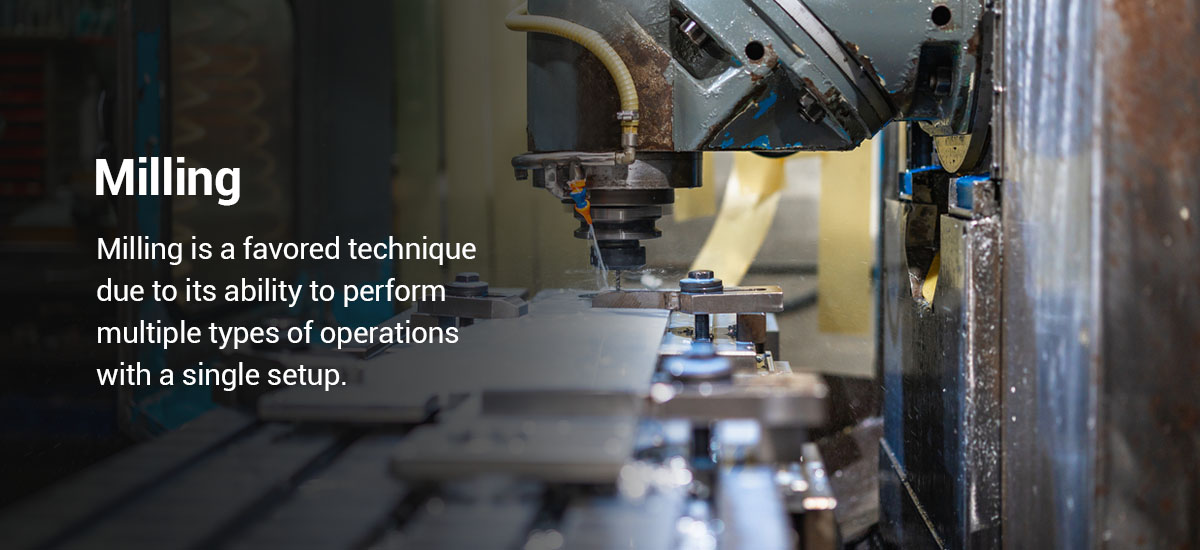
Milling is a cornerstone machining process renowned for its versatility in shaping a wide range of materials. Unlike turning, where the workpiece rotates, milling features a rotating multipoint cutting tool that contacts a stationary or moving workpiece. The tool’s rotation, combined with coordinated movements of the workpiece and cutter, enables the creation of an impressive variety of features, from flat surfaces to slots, contours and complex three-dimensional shapes.
Milling is a favored technique due to its ability to perform multiple types of operations with a single setup. Advanced technology like CNC horizontal milling machines has transformed machining precision and efficiency in modern manufacturing environments.
- Face milling: Teams can create flat surfaces through face milling. During this process, the rotating tool moves perpendicular to the axis of its rotation to quickly produce large, smooth surfaces. Face milling is ideal for squaring parts, preparing reference surfaces and achieving excellent finishes.
- Peripheral milling: Also known as plain or slab milling, peripheral milling involves the cutter’s teeth removing material along the sides of the workpiece. This operation is well-suited to machining long, straight cuts and edges. It’s ideal for creating slots, shoulders and keyways for mechanical parts.
- Contouring: Contouring is a match for more complex geometries, including two-dimensional and three-dimensional surfaces. This process allows the milling machine to follow intricate paths, carve out curves and precisely create irregular shapes. It is essential for manufacturing dies, molds and components with unique or aerodynamic profiles.
Drilling
Drilling is essential in virtually every industry for tasks such as assembly, fastening and aligning components. As the rotating drill bit advances into the workpiece, its cutting edges remove material to create holes of various diameters and depths.
Drilling operations include the following.
- Boring: Boring is a secondary operation for enlarging and refining a previously drilled hole. Boring machines use a single-point cutting tool to correct a hole’s position and size, ensuring tight tolerances and improved surface finishes. This process is particularly valuable for creating accurate bores in machinery housings and engine components.
- Reaming: This finishing operation enhances the size and finish of existing holes by removing a small amount of material from the hole to create a smooth and precisely dimensioned bore. Reaming is common for applications where exact hole diameter and high surface quality are essential, such as in precision assemblies and high-performance mechanical systems.
Tapping: Tapping is a process that creates internal threads within a drilled hole, transforming the plain hole into one that can accept bolts or screws. Tap tools cut precise threads that match specifications, making this process essential in the fabrication of parts that require threaded fasteners. The result is a reliable connection in everything from a structural framework to electronic devices.
Other Essential Machining Operations
While turning, milling and drilling are foundational to most machining operations, several other specialized processes provide unique capabilities for shaping and finishing components. These processes are less common, but are critical for some applications.
- Grinding: Grinding is an abrasive machine process that uses a rotating grinding wheel to remove small amounts of material and produce a high-quality surface finish. Grinding is ideal for finishing workpieces that require exceptional precision and smoothness, such as bearing races, tool surfaces and surgical instruments.
- Sawing: Sawing is a fundamental process for cutting material to length or for rough sizing before further machining. Using blades with multiple teeth, saws remove material by a reciprocating or continuous motion. Sawing prepares bars, tubes and plates. Band saws, circular saws or hacksaws rapidly and efficiently produce straight or contoured cuts.
- Honing: Honing is a precision finishing process that improves the surface texture and geometry of holes. Honing uses abrasive stones or sticks that move in a controlled reciprocating and rotational motion. This process achieves precise surface finishes and tight tolerances on engine cylinders and hydraulic components, ensuring optimal performance and lifespan.
Consolidate Your Machining With a Single Solution
Machining is critical for various applications across industries. Traditionally, performing multiple operations would require multiple setups. Now, advanced tools and technologies enable teams to consolidate solutions. Even the most complex machining tasks become manageable with technology and expertise.
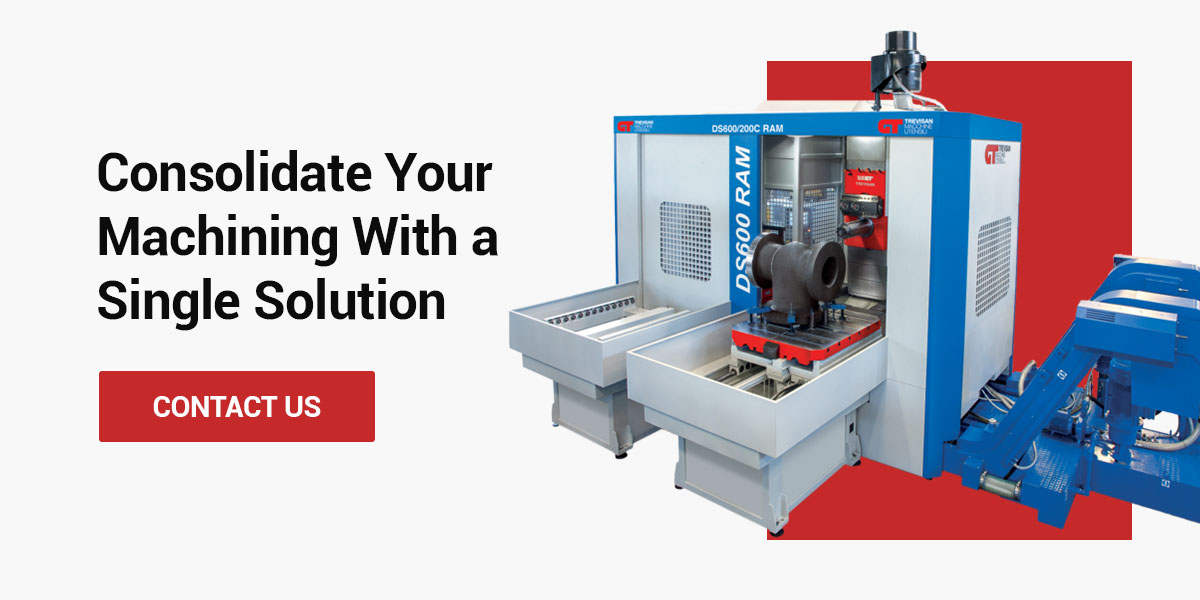
Trevisan Machine Tool’s advanced vertical and horizontal machining centers can perform numerous operations in a single cycle. Our horizontal machining centers offer one of the industry’s most comprehensive machine selections, so you can consolidate your machining. Discover how our advanced solutions can streamline your workflow and take your production capabilities to the next level.