
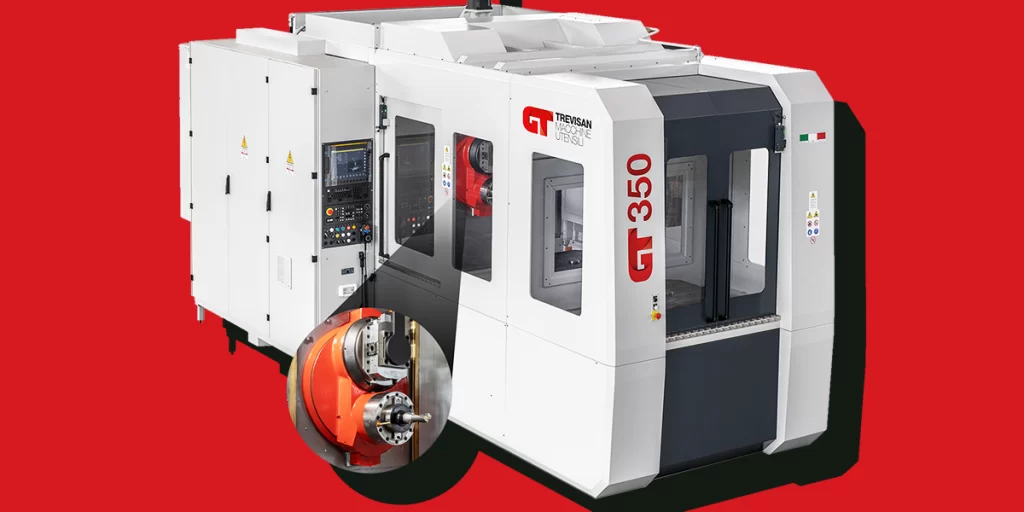
A horizontal machining center that can mill and drill is standard. One that can also face, contour, bore and turn on the same platform, in the same fixturing, without bolting on extra accessories is a superior piece of equipment.
The integrated facing head is the feature that makes this possible, and understanding why it matters will change how you evaluate your next precision machining solutions investment.
What Is an Integrated Facing Head?
An integrated facing head is a U-axis cutting system housed inside the spindle head of a horizontal machining center. It runs on its own dedicated spindle, independent of the main milling spindle, meaning two spindles, one head and zero manual swaps between operations. For example, Trevisan Machine Tools’ integrated facing heads are engineered for simple transitions between operations.
Compare that to an external or bolt-on facing head. With an add-on unit, an operator has to stop the machine, physically mount the head onto the spindle, align it, and then remove it again before the next milling operation. Every changeover introduces downtime, and every remounting introduces a fresh alignment variable.
During facing head machining, the integrated tool moves radially along the U-axis as the spindle rotates. The workpiece does not move. This aspect allows the machine to produce flat faces, bores, chamfers, contours and threads across internal and external features without the unbalanced conditions that impact large or asymmetrical parts on a conventional lathe. Trevisan machines are designed to maintain precision on even the most challenging large or asymmetrical components.
Tools feed from the automatic tool changer directly into the facing head. Switching from a milling operation to a turning operation happens through a programmed command, with no intervention from the operator. You end up with a single platform that does the work of a mill, a lathe and a boring machine.
When Do You Need an Integrated Facing Head?
Some machining work does not call for a facing head. However, there are specific situations where trying to get by without using an integrated facing head creates problems. It is recommended to use an integrated facing head in the following scenarios:
- Oversized or heavy components: Parts like valve bodies, pump housing, fluid ends and gearbox casing add a challenge to conventional lathes because of their size and weight distribution. Rotating a 2,000-pound casting to turn a few features is not only impractical — it is a safety concern. An integrated facing head performs those turning operations while the part sits stationary on the table.
- Multi-operation parts: A component that needs milling, boring, facing, contouring and threading should not have to travel across three machines to get finished. Every transfer between machines stacks up alignment errors and adds fixturing time. Keeping everything in one setup removes those variables entirely.
- Offset and nonconcentric features: Turning offset diameters or features that sit off the part’s centerline is notoriously difficult on a lathe. The rotation creates vibration and instability. A facing head on a horizontal machining center turns at any point on the workpiece without those issues because the part never spins.
- Tight-tolerance production at volume: Every additional setup is another chance for dimensional drift. Shops running hundreds or thousands of identical components benefit from eliminating changeovers. The first part and the five-hundredth part come off the machine with the same accuracy. Trevisan machines are built to deliver consistent accuracy across high-volume production runs.
If your shop is currently shuttling parts between a mill and a lathe, or your operators spend 20 minutes mounting and aligning a bolt-on facing head before each use, that accumulated downtime and risk is exactly what an integrated solution eliminates.
Advantages Over Traditional Solutions
Bolt-on facing heads are a trusted solution for occasional, low-precision facing work. However, the gap between a bolt-on accessory and an integrated system quickly presents itself once tolerances tighten, volumes increase or part complexity grows.
Reduced Setup Time
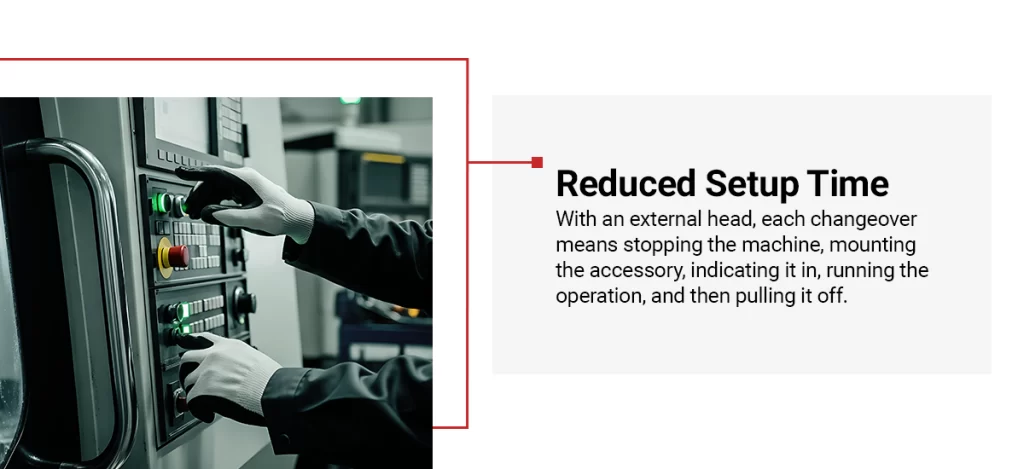
With an external head, each changeover means stopping the machine, mounting the accessory, indicating it in, running the operation, and then pulling it off. Depending on the setup, that process can take 15 to 30 minutes per cycle. Multiply that across a full production run, and the lost spindle time is substantial.
Reduced setup time with an integrated facing head comes from the fact that none of those steps exist. The head is always in the machine, tools are loaded from the magazine, and the CNC handles the transition. Spindle uptime stays where it should be.
Tighter Tolerances, More Consistent Results
An external facing head bolts onto the spindle through a mechanical interface. That interface is a weak point. Over hundreds of hours of use, wear develops, and with it comes play. Even small amounts of runout or deflection at the tool tip will show up in surface finish and dimensional accuracy.
An integrated facing head avoids this problem. The U-axis rides within the machine’s own structural casting, guided by the same CNC feedback loops and servo systems that control the X, Y and Z axes. On applications where surface flatness or concentricity needs to hold within a few thousandths, that rigidity is not optional. Trevisan Machine Tool machining centers feature this structural integrity for unparalleled precision.
Smaller Footprint, Lower Capital Outlay
One machine doing the work of three means two fewer machines on the floor. That frees up square footage, reduces tooling inventory and simplifies scheduling. For shops operating in tight quarters or looking to add capacity without expanding their facility, consolidating onto a single horizontal center with an integrated facing head is a practical step forward.
Broader Range of Machinable Parts
Back-facing, single-point threading and large-diameter contouring become routine when the facing head is built in. Without it, shops either turn the work away or piece together workarounds on equipment that was not designed for the task. In sectors like oil and gas, aerospace, defense, and heavy equipment manufacturing, that expanded capability translates directly into the ability to bid on more complex jobs and deliver them faster.
Explore Trevisan’s Integrated Facing Head Machining Centers
Deciding to use an integrated facing head starts with looking honestly at what your current equipment can and cannot do in a single setup. If parts are moving between machines, operators are spending time on manual changeovers, or geometry is limiting what jobs you take on, the answer is already taking shape.
Trevisan Machine Tool has engineered horizontal machining centers with integrated U-axis facing heads for over 60 years. Our dual-spindle design handles milling and turning in one fixturing, with turning capacities reaching 3 meters in diameter. From compact cells to heavy-duty dual-column platforms, every machine we build is configured to cut cycle time, remove changeovers and hold tight tolerances on demanding components.
We work with each customer to match the right configuration to their specific application. Contact our team to discuss what we can do for your production.
